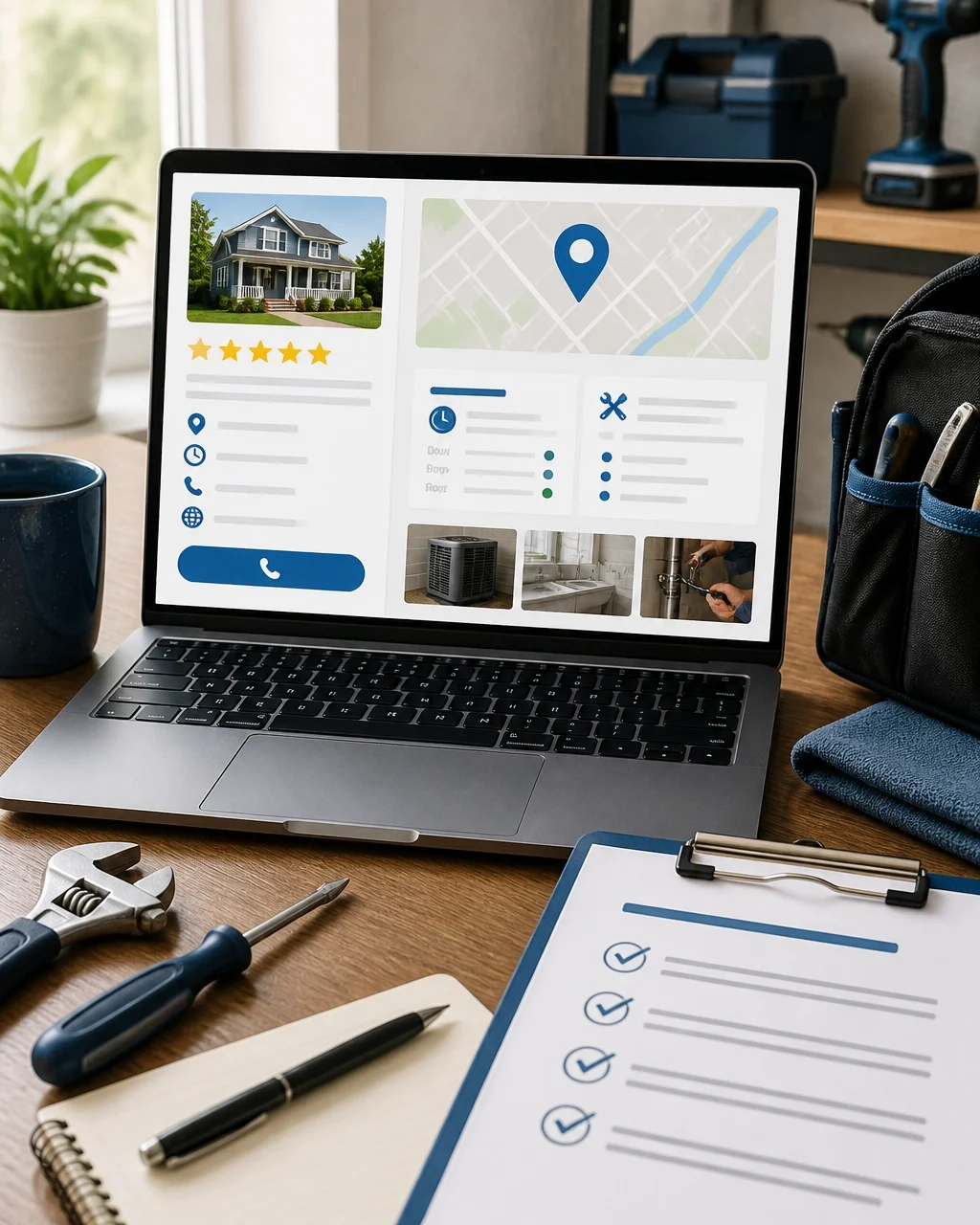
Many local businesses do not need another lead marketplace. They need a reliable system that helps nearby customers find them, trust them, and take the next step.

A local business can spend heavily on lead services and still struggle to keep the phone ringing.
The problem is often not a complete lack of demand. It is that potential customers cannot find the business easily, cannot tell whether it is trustworthy, or do not have a simple way to request help. Paying for more leads does not fix those problems. It may only make each missed opportunity more expensive.
A better approach is to build a basic lead-generation system around three stages:
1. Visibility: Customers can find the business when they need it.
2. Trust: They can see enough evidence to feel comfortable making contact.
3. Action: Calling, messaging, booking, or requesting a quote is straightforward.
This framework can work for plumbers, electricians, HVAC companies, contractors, realtors, accountants, attorneys, restaurants, retailers, and professional practices. It does not eliminate all marketing costs: your time, website, software, photography, and staff attention still have value: but it can reduce dependence on paid advertising and third-party lead marketplaces.
1. Start with the customer problem, not the marketing channel
Before changing your website or opening another social media account, answer four questions:
What service do you want more customers to request?
Which locations can you serve profitably?
What problem causes customers to search for that service?
Why should someone choose your business instead of calling the next result?
A plumbing company may want more water-heater replacements rather than more general inquiries. An electrician may want residential panel upgrades in specific towns. An HVAC company may want maintenance agreements or emergency repairs.
This distinction matters because broad marketing attracts broad attention. Specific marketing makes it easier for the right customer to recognize that you are relevant.
Write down one primary service, one customer type, and one service area. Use that combination as the starting point for your lead-generation work.
2. Make your Google Business Profile accurate and useful
For many local businesses, a Google Business Profile is an important free-search asset. It allows a business to provide information that may appear in Google Search and Maps, including its name, category, hours, service area, photos, phone number, and website.
Google says local results are mainly influenced by relevance, distance, and prominence. It also states that businesses cannot pay to receive a better local ranking. That means the goal is not to manipulate the profile. The goal is to represent the business accurately and make it useful to potential customers.
Start with the basics:
Use the real-world business name.
Choose the most specific primary category that accurately describes the business.
Add only appropriate additional categories.
Use accurate hours, including relevant holiday or seasonal changes.
Identify the actual service area.
Add the main services customers request.
Use a phone number controlled by the business.
Upload genuine photos of the team, vehicles, location, equipment, and completed work.
Service-area businesses should pay particular attention to address rules. If customers do not visit your location and you travel to them, Google’s guidelines may require you to hide the address and use a service area instead. Do not create extra profiles for individual towns simply to appear in more places.
Read Google’s guidelines for representing your business before making major changes. Incorrect business names, virtual offices, duplicate profiles, or inaccurate locations can create problems.
For the step-by-step work of claiming, verifying, categorizing, and improving a listing, see the detailed guide on improving your Google Business Profile for a local service business.
What this solves
A complete, accurate profile helps customers answer basic questions before they call:
Do you offer the service I need?
Do you work in my area?
Are you open?
How can I contact you?
Does this look like a legitimate business?
Who may not need extensive profile work?
A business that does not serve local customers, such as a fully remote software company with no location-based service, may need a different search strategy. However, most businesses that visit customers, receive customers, or operate from a physical location should review their eligibility and profile information.
3. Build website pages around real services and locations
A home page that says “quality service at a fair price” is not enough. Customers usually search for a specific problem, such as:
Emergency plumber in a particular town
Furnace repair near a neighborhood
Residential electrician for a panel upgrade
Commercial roofing contractor
Realtor for first-time buyers
Create a clear page for each important service. A useful service page should explain:
The problem the service addresses
Signs that the customer may need it
What your company actually does
What the process involves
The areas you serve
What happens after a customer contacts you
Common questions
The next action to take
You can also create location pages when you genuinely serve those locations. Each page should contain useful, distinct information: not the same paragraph with a town name swapped in.
Every important page should make contact easy. Include a visible phone number, a click-to-call option on mobile, a short quote form, and clear expectations about response time if you can state them accurately.
Do not publish service areas you do not actually serve. A visitor who submits a request and later learns that you cannot help has not become a useful lead; they have had a poor customer experience.
4. Turn completed jobs into honest proof
People hiring a contractor, repair company, attorney, accountant, or other professional are taking a risk. They want evidence that the business has handled similar work responsibly.
Build proof from ordinary operations:
Photograph completed work with customer permission.
Explain the original problem and the work performed.
Show staff, vehicles, facilities, or equipment where relevant.
Publish answers to questions customers regularly ask.
Keep licenses, qualifications, service claims, and guarantees accurate.
Ask satisfied customers for honest reviews.
Google permits businesses to ask customers for reviews using a review link or QR code. It prohibits offering free or discounted goods or services in exchange for reviews, changing reviews, or removing negative reviews. Read Google’s review guidance before creating a review process.
A simple process might look like this:
1. Finish the job and confirm the customer understands the result.
2. Send a polite review request through your normal customer communication method.
3. Make the request easy to complete.
4. Send one reasonable reminder if appropriate.
5. Respond professionally to the review.
Do not pressure customers to leave only positive reviews. Do not write reviews for customers. Do not disclose private details while responding publicly.
A negative review is not automatically a marketing disaster. Respond briefly, protect the customer’s privacy, acknowledge legitimate concerns, and move the detailed conversation offline.

5. Create referral relationships deliberately
Referrals do not have to be complicated. Start by identifying people and businesses that already serve the same customers without competing directly with you.
Examples include:
Plumbers and electricians
HVAC companies and insulation contractors
Realtors and home inspectors
Property managers and repair companies
Landscapers and exterior contractors
Accountants and business attorneys
Wedding venues and photographers
Auto repair shops and towing companies
The best referral relationship is based on dependable service, clear boundaries, and a good experience for the customer. A referral partner should know exactly what you do, where you work, and which customers are a good fit.
After a successful job, you can ask a simple question:
“If someone you know needs this service, would you feel comfortable passing along our information?”
You can also add a short referral reminder to invoices or follow-up messages. Be careful with paid referral arrangements and incentives. Requirements may vary by industry and location, particularly in regulated professions. Verify the applicable rules before offering compensation.
6. Participate in local communities without becoming spam
Neighborhood groups, local forums, community organizations, and professional associations can create visibility, but only when participation is useful.
Good contributions include:
Explaining how to prepare for a seasonal problem
Answering a basic maintenance question
Warning homeowners about a common mistake
Sharing a checklist
Giving a clear explanation of when professional help is necessary
Do not reply to every post with “Call us.” Do not use fear to create demand. Do not pretend to offer neutral advice when the real purpose is to sell.
A business owner can also support local organizations, attend community events, or contribute useful information to neighborhood newsletters. These activities may take longer than posting an advertisement, but they can help people understand who the business serves and how it operates.
7. Use a weekly system instead of occasional marketing bursts
Consistency matters more than a large one-time effort. A simple weekly routine might include:
Monday: Request reviews from recently completed jobs.
Tuesday: Respond to new reviews and customer questions.
Wednesday: Add or improve one service-page FAQ.
Thursday: Contact one past customer or referral partner.
Friday: Review calls, forms, messages, and quoted jobs by source.
Track where inquiries came from. Add a simple question to your intake process:
“How did you find us?”
Record answers such as Google Search, Google Maps, referral, website, community group, repeat customer, or another source. Also track whether the inquiry was in your service area, whether it became a quote, and whether it became a job.
The point is not to create a complicated dashboard. It is to learn which activities produce suitable opportunities and which ones consume time without producing useful conversations.

What not to expect
Organic visibility and referrals are not instant replacements for paid advertising. Results can vary by market, competition, service, reputation, location, and execution.
You may also discover that your real problem is not lead volume. It may be:
Calls going unanswered
Slow quote follow-up
Unclear pricing expectations
Poor scheduling
Weak service-area coverage
Customers contacting you for services you do not provide
Fix the operational problem before adding more demand. More inquiries will not help if the business cannot respond promptly or deliver the promised service.
A practical 30-day starting plan
Week 1: Audit your Google Business Profile, website contact information, hours, services, and service areas.
Week 2: Improve one important service page and add a clear contact path.
Week 3: Install a consistent, policy-compliant review request process and respond to existing reviews.
Week 4: Contact four potential referral sources and review the origin and quality of recent inquiries.
At the end of the month, choose the one activity worth repeating. Build from evidence rather than adding another marketing channel because it is popular.
Questions to ask before buying a lead-generation service
If you later consider a directory, lead marketplace, marketing agency, CRM, or review-management tool, ask:
Do I receive exclusive leads or shared inquiries?
How is a lead defined?
Can I see the customer’s location and requested service before accepting it?
What happens when the lead is outside my service area?
Is pricing per lead, per month, per user, or based on another model?
Is there a contract or cancellation period?
Can I export my customer and lead data?
Who owns the website, profile, phone number, and content?
How are reviews requested, stored, and managed?
Does the service comply with applicable platform and industry rules?
What work will my staff still need to do after the lead arrives?
Do not buy a tool to compensate for an unclear offer, slow follow-up, or inaccurate online information.
Start with one service and one location. Audit how a customer would find you, evaluate you, and contact you today. Fix the largest obstacle first, then repeat the process every week.
For more practical guidance on tools, systems, marketing, and business growth, keep exploring the resources available here.